
What Is a Prism Correction in Glasses? 5 Things to Know
Two small numbers in the corner of your prescription can decide whether the world looks single or double.
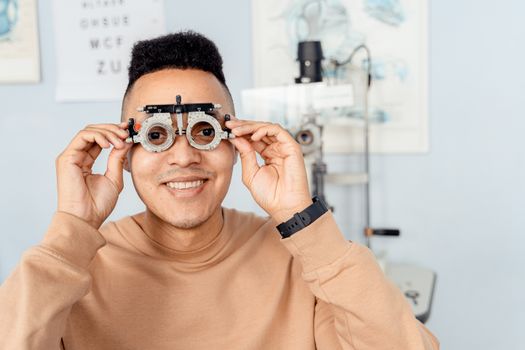
Photo by Antoni Shkraba / Pexels
A prism correction is a lens power that bends light without magnifying it, shifting where an image lands in your eye. Opticians add it, measured in prism dioptres (Δ) with a base direction, when your eyes point slightly out of line, so both eyes receive the same picture.
1. What does a prism do in glasses?
Prism in glasses shifts the image your eye sees by a fixed amount in a fixed direction, without changing focus. One prism dioptre (1Δ) displaces an object by 1 cm when viewed from 1 metre away. Sphere and cylinder powers fix blur; prism fixes alignment. If your eyes rest slightly out of line, your brain pulls them together every second to avoid seeing double, and some people feel that effort as tired eyes or headaches when reading. A prism lens takes over part of that work. It bends incoming light towards its thick edge, the base, so the image lands on matching spots in both eyes. What you see is shifted towards the thin edge, the apex, and the brain fuses it into one picture. Amounts are usually small, often between 0.5Δ and a few dioptres, and your optician decides the figure, not you.
One detail most explainers skip: prism is often split between the two eyes. A total need of 4Δ may appear as 2Δ in each lens, so a prescription can look milder than the correction really is.
Shop the frames in this guide


2. How do you read prism on a prescription?
Look for columns headed Prism and Base, usually next to sphere (SPH), cylinder (CYL) and axis. Prism is a number in prism dioptres, for example 1.50. Base is a direction: BU (base up), BD (base down), BI (base in, towards the nose) or BO (base out, towards the ear). In the UK you will often see these four abbreviations written out on an optician's prescription, although some practices give the base as an angle from 0 to 360 degrees instead. Horizontal prism (BI or BO) deals with eyes that drift outwards or inwards. Vertical prism (BU or BD) deals with one eye sitting higher than the other. Both can appear together, and each eye has its own row, so read right and left separately. If a row is blank, no prism is prescribed for that eye.
| Abbreviation | Means | Direction of correction |
|---|---|---|
| BU | Base up | Vertical alignment |
| BD | Base down | Vertical alignment |
| BI | Base in (towards nose) | Horizontal alignment |
| BO | Base out (towards ear) | Horizontal alignment |
Our advice: copy the prism and base values exactly as written, and never round them. A 1.5Δ lens and a 2Δ lens are not interchangeable.
3. Who needs a prism correction?
People need prism when their eyes do not line up perfectly at rest. That ranges from a mild tendency to drift (a phoria) to a clear turn of one eye (strabismus). Prism is also prescribed for trouble pulling the eyes together at reading distance, called convergence insufficiency, and for double vision (diplopia) that follows illness or injury. Many people with a small phoria never notice it, while others get double images, tired eyes after screen time or a tendency to lose their place on the page. Only an eye examination can tell which group you are in, and the optician may test your alignment with cover tests or special charts. Sudden double vision is different: it needs prompt attention from a doctor or optician, not a new pair of glasses. We cannot diagnose anything here, so if reading or screens feel strangely hard, ask your optician to test eye alignment.
- Prism is not something you can pick yourself, the way you might pick a sun clip.
- Ready-made glasses and generic reading glasses do not contain it.
- Your needs can change, so an old prism value is no guide to a new one.
4. Does prism make lenses thicker?
Yes, prism adds thickness at the base edge, because the lens is effectively a wedge. A small prism of 1Δ is barely visible. At 4Δ or more, you may see a thick lower or inner edge that changes how the lens looks in the frame. Labs create prism either by grinding the wedge into the lens or by shifting the optical centre away from your pupil, which needs a larger lens blank. Both routes favour smaller frames, since less lens area means less visible thickness. Higher-index materials (1.61, 1.67 or 1.74) trim the thickness and weight, and a light frame helps carry the result. There is a catch: higher indices show more colour fringing at the edges, and prism makes that more noticeable. We would not automatically jump to 1.74 for a low-power lens with prism. Ask which index suits your numbers.
- Pick a frame with modest eye width, so the lens blank stays small.
- Consider titanium or thin metal frames if the lenses are heavy.
- Add an anti-reflective coating, which cuts the ghost reflections that thicker lenses throw off.
- Rimless styles expose the wedge edge, so a full rim often looks tidier with strong prism.
5. What should you check before ordering prism glasses online?
Check that your prescription is current, that the prism and base values for each eye are copied exactly, and that your pupillary distance (PD) is accurate. PD matters more than usual here, because a lens worn off-centre creates prism by itself. Prentice's rule says induced prism equals the decentration in centimetres multiplied by the lens power. A +4.00 lens sitting 5 mm off your pupil adds 2Δ you never asked for. With a prescribed prism, an error like that can cancel part of the correction or push it the wrong way. Take your time over the measurements, and before paying, confirm with the retailer that your exact prism values can be made.
- Read your prescription and note prism and base for both eyes.
- Get a PD from your optician, ideally as two single figures (one per eye) when your prescription lists them.
- Choose a lens index with your numbers in mind (see section 4).
- Add anti-reflective coating.
- Ask the retailer in writing whether your prism values are supported, then wait for a yes.
Most people who ask us about prism are really asking about comfort, so when the glasses arrive, wear them for a few days, indoors first. Mild adjustment is common with any new prescription. If double vision or strong discomfort persists, go back to your optician.
Where to find frames for a prism prescription
Lensdy has 200+ frame styles in acetate, metal, titanium, rimless and flexible memory metal, with affordable prescription lenses in single vision, progressive, blue light blocking and photochromic options. For prism, we would start with compact full-rim shapes, where the lens blank stays small. Try a look at Glacier or ClearGrey to see how that style sits on your face, or take a wider look at Toffee Purple and Liberty Pink if you want colour. Browse the full Prescription Glasses collection and filter by size to keep lens width down.
free shipping on orders over €59 applies on orders over €59, and most orders arrive within 1-2 weeks. Contact the Lensdy team with your prescription before you buy, so the prism is confirmed first. Then head to lensdy.com and start with a frame small enough to flatter your numbers.