
Glasses for Hyperopia That Do Not Magnify Your Eyes
Plus lenses make your eyes look bigger. That is physics, not a fault in your glasses, and you can still keep it under control.
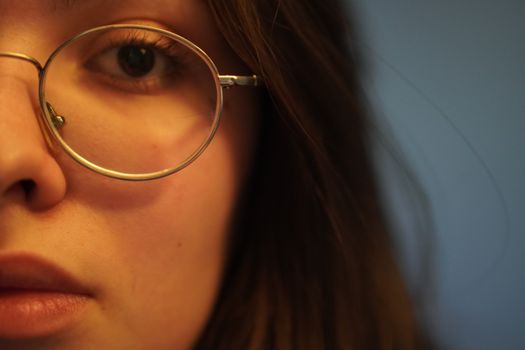
Photo by Zeynep Altuntaş / Pexels
You cannot remove magnification from a plus prescription, but you can shrink it until few people notice. Pick a higher lens index (1.61 or 1.67 once you pass about +3.00), choose a smaller frame whose lens centres match your pupillary distance within a few millimetres, add anti-reflective coating and favour a darker or patterned rim.
Why do glasses for hyperopia make your eyes look bigger?
Hyperopia is corrected with plus (convex) lenses, which are thicker in the centre than at the edge. A convex lens bends light inward, so anyone looking at you through it sees your eye enlarged. Two factors drive the effect. The first is power: your prescription in dioptres. The second is shape: how steeply the front surface curves. A bulging front curve adds extra enlargement on top of what the power already causes. That is why +1.00 is invisible to everyone but you, while +5.00 can give the fishbowl look. Many people start to notice it from around +3.00, though face shape and frame size change the threshold. You cannot reduce the power factor, because it is what lets you see clearly. The shape factor is where you have room to work, through lens index, frame size and how close the lenses sit to your eyes. The rest of this article targets that second part.
Shop the frames in this guide


Which lens index makes hyperopic eyes look smallest?
A higher index makes your eyes look smaller, up to a point. Higher-index material bends light more efficiently, so the lens maker can use a flatter front curve to deliver the same dioptre power. A flatter curve means less bulge, less centre thickness, less weight and less of the shape-driven enlargement. It does not change the power factor, so a +6.00 lens will still enlarge your eyes more than a +2.00. We would move up an index the moment your plus power makes the lens visibly domed in the middle. For mild prescriptions, the standard 1.56 index is perfectly fine and the extra cost is wasted.
Our rule of thumb for plus prescriptions (your optician may adjust it for your frame):
| Plus power (sphere) | Index to consider | What you gain |
|---|---|---|
| Up to about +2.00 | 1.56 | Enough; enlargement is barely visible |
| +2.00 to +4.00 | 1.61 | Flatter front curve, lighter lens |
| +4.00 to +6.00 | 1.67 | Noticeably less dome and weight |
| Above +6.00 | 1.74 | Flattest, thinnest option we offer |
Our Prescription Glasses collection offers all four indices.
What frame size and fit reduce the magnified look?
A smaller frame that sits close to your face reduces the magnified look. Enlargement is strongest where the lens is thickest, so a smaller lens shows less of the bulge, and a lens that sits further from your eye magnifies it more. A frame whose lens centres line up with your pupils lets the lens maker use a smaller blank with less thickness. The mistake we see most is chasing the smallest frame possible. If your pupils land near the edge of a tiny lens, the optical centre shifts and the result looks worse, not better. Match the frame to your face first, then keep the lens modest. For strong plus prescriptions, eye sizes in roughly the 46-52 mm range tend to be easier to work with than very large lenses, though it depends on your PD.
Here is how to check a frame in four steps:
- Find your PD on your prescription, or measure it with a ruler in a mirror. Adult PD is typically 54-74 mm.
- Add the frame's lens width and bridge width (printed on the temple, for example 49-19). That sum is the centre distance.
- Aim for a centre distance within about 2-4 mm of your PD. With a PD of 62 mm, a 47-17 frame (64 mm) sits well.
- Ask for the nose pads to be adjusted so the lenses sit as close to your eyes as your lashes allow. A greater lens-to-eye distance increases the enlargement others see.
Do anti-reflective coating and frame colour help hide the effect?
Yes, both help, though neither changes the optics. Anti-reflective coating removes most surface glare, so people see your eyes instead of a bright window across a domed lens. Convex surfaces catch reflections in a large curved band, and that band draws attention to the lens bulge, which makes the enlargement look worse than it is. Frame colour works on perception. A darker rim, tortoiseshell pattern or a slightly thicker acetate edge visually contains the lens and breaks up the outline of the magnified eye. A thin, pale metal rim does the opposite, because it lets the curve of the lens do the talking. Our advice: avoid rimless and very light, thin frames if your plus power is strong, because the lens edge and dome are fully exposed from the side. If you also want to filter HEV/blue light or have lenses that darken outdoors, choose those on top of the coating, not instead of it.
What should you check before ordering?
Check four things before you order: your sphere value, your PD, the frame's centre distance and the lens index. A plus sign in the sphere column means hyperopia, and the number tells you how much enlargement to plan for. Then check that the frame's lens width plus bridge lands near your PD, and choose an index that fits the power bands above. Finally, read the frame's dimensions on the product page instead of judging by photos, because a frame that looks small on a model can be wide on a narrow face. Taking five minutes with a ruler beats guessing and then paying for a second pair. If your eyes feel odd or your vision is blurred after you start wearing new lenses, ask your optician rather than waiting it out.
- In Italy your prescription may use the abbreviations SF (sfero) and CIL (cilindro). A positive SF value is your plus power.
- Write down your PD. If your prescription lists two figures, one per eye, send both.
- Choose the lens index from the table, moving up one step if you pick a large frame.
- Add anti-reflective coating.
- Choose a frame with a darker or patterned rim and a centre distance close to your PD.
Where can you buy hyperopia glasses that look natural?
You can order them online from Lensdy, where more than 200 frame styles in acetate, metal, titanium and flexible memory metal are paired with affordable prescription lenses. That range makes it easy to find a frame at the size and colour that works for plus lenses. If you want a dark rim to frame the lens, look at Sleek Black. For warmer colours, try Toffee Brown or Toffee Purple. If you would rather have a bolder look, Oscar Red draws attention to the frame. Check each frame's dimensions against your PD using the steps above. Most orders arrive within 1-2 weeks, and shipping is free on orders over €59.
Ready to find your pair? Browse the prescription glasses at lensdy.com, pick your index and add anti-reflective coating at checkout.