

Glasses Fishbowl Effect: Wrong Prescription or Wrong Fit?
Floors that seem to tilt upward, door frames that bow, a faint seasick feeling on the stairs. If that sounds like your new pair, you are not imagining it.
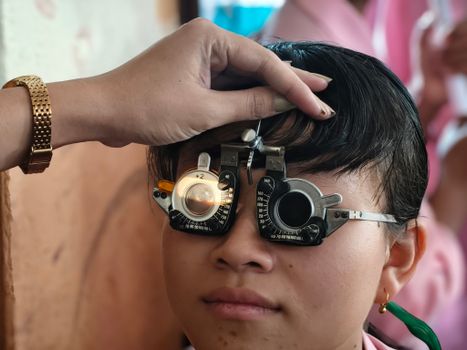
Photo by Kosygin Leishangthem / Pexels
The fishbowl effect appears when a lens bends light unevenly from centre to edge, so straight lines curve near the periphery. The usual causes are a strong or recently changed prescription, a lens curve that does not suit its power, or a frame that sits at the wrong distance or angle from your eyes. Fit problems are fixable; adaptation fades on its own.
Below we separate the causes, show you how to tell which one you have, and explain what to change when you order your next pair.
What actually causes the fishbowl effect in glasses?
Your glasses create a fishbowl effect because a lens is not equally powerful across its whole surface. Light passing near the edge is bent differently from light passing through the optical centre, so straight lines near the periphery look curved and the image seems to swell or shrink. Strong prescriptions amplify this. A minus lens (for short-sightedness) is thin in the centre and minifies, so the world looks slightly smaller and the edges pull inward. A plus lens (for long-sightedness) magnifies and can make the edges bulge. Lens makers counter this by choosing a base curve, the curvature of the front surface, that suits the power, and by flattening the lens edge with aspheric designs. If the curve, the power or the lens position in front of your eye is off, your brain notices, mostly when you turn your head or look down at the floor.
Three separate things are usually mixed up under the one name:
- Magnification or minification, caused by the lens power itself.
- Peripheral curvature, caused by lens shape, base curve and size.
- Positioning errors, caused by frame fit, pupillary distance (PD) and tilt.
Only the first is built into your prescription. The other two are choices made when the glasses were designed and fitted, which is good news, because choices can be changed.
Shop the frames in this guide


Is it your prescription or your frame fit?
A quick rule: if the warping changes when you push the glasses closer to your face or tilt them slightly, it is fit. If it stays identical however you position them, and a different frame gives the same result, it is the prescription itself, usually a stronger power, a new cylinder (astigmatism) value or a shifted axis. Fit problems tend to feel worse in one particular gaze direction, such as looking down. Prescription changes feel like a general swimming sensation that eases over days. A third suspect is a PD or optical centre error, where the lens centre does not sit in front of your pupil, which adds an unwanted prism effect and can feel like pulling or tilting. You can narrow it down in a few minutes with the comparison below.
| Clue | Points to prescription | Points to fit or design |
|---|---|---|
| Moving glasses closer or further changes it | No change | Clear change |
| Old glasses feel normal, new ones warped | Power, cylinder or axis changed | New frame is larger or sits differently |
| Worse looking down at the floor | Possible with new astigmatism correction | Often tilt or vertex distance |
| Pulling or tilting sensation | Rare | PD or optical centre misaligned |
| Colour fringes at the edges | Not usually | High-index lens in a large frame |
| Fades within a week or two | Typical adaptation | Unlikely to fade alone |
One thing we see people miss: the old pair is the best reference you have. Put both prescriptions side by side. A change in sphere of a quarter or half a dioptre is barely noticeable. A change in cylinder of 0.50 or more, or an axis that has rotated by 10 degrees or so, is much more likely to produce the warped, tilted feeling, even when the overall power is similar.
Does a stronger prescription always mean a stronger fishbowl effect?
Strong prescriptions raise the risk, but they do not guarantee the effect. Above roughly ±4.00 dioptres, edge distortion and size change become visible to many people, and by ±6.00 most notice something. But a well-designed lens in a small, well-fitted frame can feel comfortable even at high power, while a mild prescription in a huge, badly tilted frame can feel strange. Power sets the baseline, and lens shape, lens size and eye-to-lens distance decide how much of it you feel. Astigmatism matters just as much as the headline number, because cylinder stretches the image along one axis. That is why someone at -2.00 with a new cylinder can complain more than someone at -5.00 who has worn the same axis for years. Your brain learns a particular distortion and then expects it.
Practical consequences:
- Low prescriptions (under ±2.00) rarely cause true fishbowl. If you get it, look at fit and PD first.
- Medium prescriptions (about ±2.00 to ±4.00) respond well to better frame choice and a sensible lens index.
- High prescriptions (above ±4.00) need a smaller lens shape, a higher index and careful centring.
Do high-index and aspheric lenses reduce the fishbowl effect?
Partly. A higher index (1.61, 1.67 or 1.74) allows a thinner, flatter lens, which reduces edge thickness and the bulging look, and aspheric surfaces flatten the periphery to cut curvature distortion. But index does not change the magnification caused by your power. A -6.00 lens still minifies whether it is 1.56 or 1.74. What a higher index changes is how much lens sits between your eye and the frame edge. Each step up comes with a trade-off: higher-index materials generally have lower Abbe values, which means more colour fringing toward the edge. People sometimes read that fringing as fishbowl, so if you see rainbow edges on bright lights, that is a different issue with a different fix, usually a smaller frame or a more central gaze.
As a rough ordering, the index choice usually follows power:
- 1.56: comfortable for low powers, up to about ±2.00.
- 1.61: a sensible step for roughly ±2.00 to ±4.00.
- 1.67: for roughly ±4.00 to ±6.00, where a thinner edge becomes noticeable.
- 1.74: for strong prescriptions beyond that, especially in minus.
These are guidelines, not rules. Plus lenses are thickest in the centre, so they benefit from higher index too, mainly for weight and bulge. Our separate guide on lens index goes deeper if you want the full comparison. An anti-reflective coating will not alter the geometry, but it removes the secondary reflections that make a thick lens look busier and feel more distorting in bright light.
How do frame size, tilt and nose pads change the distortion?
Frame fit changes the fishbowl effect because three measurements decide where the lens sits in front of your eye: vertex distance (lens to cornea, typically around 12 mm), pantoscopic tilt (the forward lean of the lens, often around 8 to 10 degrees) and lens size. Move the lens further away and a plus lens magnifies more, a minus lens minifies more. Increase the tilt wrongly and you add unwanted astigmatism when you look straight ahead. Choose a big lens and you look through more of the periphery, where distortion is worst. At powers above ±4.00, even a 2 mm change in vertex distance can shift the effective power enough to feel. That is why a tiny nose pad adjustment can transform a pair that felt unusable.
What to look for when you choose a frame:
- Smaller lens shapes keep your gaze near the optical centre. A lens width in the 46 to 50 mm range often suits strong prescriptions better than a 54 mm oversized shape.
- Nose pads or a bridge that sit close keep the vertex distance short. Your eyelashes should almost, but not quite, brush the lens.
- Moderate wrap only. Strongly curved wraparound frames add peripheral distortion, so keep them for plain-lens sports use.
- Bridge width that matches your nose, so the glasses do not slip forward and increase the distance through the day.
Here is the counterintuitive bit: the current oversized trend is the worst match for a strong prescription. A large lens does not just look big. It forces the edge of the lens into your field of view and makes the thickest part of the lens part of your daily vision.
How long does it take to get used to new glasses?
Most people adapt to a mild fishbowl effect within a few days, and almost everyone within about two weeks, as the brain recalibrates how it reads distance, floor level and straight lines. Wearing the new pair full-time speeds this up. Switching between old and new glasses resets the process each time, so avoid that during the first week. If the distortion is still strong after two weeks, or you get headaches, nausea, or a persistent pulling sensation, stop trying to tough it out and go back to your optician or check the order details. A prescription that gives genuine ongoing discomfort deserves a recheck, and anything involving eye health or symptoms should be discussed with your optician rather than self-diagnosed.
Things that lengthen the adaptation:
- A first prescription, or a big jump from your previous one.
- A new or rotated axis on astigmatism.
- A first pair of progressive (varifocal) lenses, where the lower sides naturally blur and sway. That is a different effect, often called swim, and it needs head movement habits rather than a new frame.
- A much larger or more curved frame than your last one.
Short-term tricks: walk down a flight of stairs slowly, hold the rail, look at the steps rather than far ahead, and read for a few minutes with your head turned slightly. Controlled exposure works better than avoiding the glasses.
What can you check at home before blaming the lenses?
You can test most causes in ten minutes with a ruler, a mirror and a straight line. Start by confirming the glasses match your prescription, then check where they sit on your face, then test the distortion against a grid. Do these in order, because a PD or position error can mimic a prescription error. Not every result is conclusive, but together they tell you whether to ask for an adjustment, a remake or just more time. Keep the prescription and your PD measurement to hand, since either can be quoted back to a supplier.
- Compare prescriptions. Line up sphere, cylinder and axis from the old and new versions. Note anything that moved by 0.50 dioptre or more, or an axis shift.
- Check PD. Adult PD typically falls between 54 and 74 mm. Hold a ruler against your brow, look straight into a mirror and check that your pupils line up with the optical centres. A 2 to 3 mm offset on a strong lens can be felt.
- Check distance. Your lashes should come close to the lens without touching. If there is a wide gap, ask for the pads to be adjusted inward or the frame to be tightened.
- Check tilt. Viewed from the side, the bottom of the lens should sit slightly closer to your cheek than the top.
- Do the grid test. Look at a tiled wall or a door frame, then slowly turn your head. Lines that bow only at the extreme edge are normal. Lines that bow in the middle are not.
If the checks point to fit, a small adjustment is often all it takes. If you want a refresher on what you can safely do yourself, our piece on DIY versus professional adjustments covers it.
Which Lensdy glasses help if you get a fishbowl effect?
Start from the lens, then pick the frame. At Lensdy you can choose among 1.56, 1.61, 1.67 and 1.74 indices for single vision or progressive lenses, so a stronger prescription does not have to mean thick, heavy edges. Add an anti-reflective coating if reflections make the lens feel busier. Then choose a frame whose lens shape is on the smaller side and whose bridge suits your nose. With more than 200 frame styles in acetate, metal, titanium, rimless and flexible memory metal, there is usually a shape that keeps your gaze close to the optical centre.
Some places to begin browsing:
- ClarityEdge-Black for a defined, classic outline that is easy to compare against your last pair.
- Delicate - Silver if you prefer a light, understated look.
- SoftGlow and Cuban are worth a look if you want to try a different shape from your current one.
Whichever you pick, compare the lens width and bridge measurements on the product page with your current glasses. If your old pair felt natural, a similar width and bridge is the safest starting point. You can browse the whole prescription glasses collection and filter by what you need. Prices for prescription lenses are affordable, free shipping on orders over €59 applies on orders over €59, and most orders arrive within 1 to 2 weeks, which leaves enough time to test the pair properly during the adaptation period.
One practical tip when ordering: enter your PD carefully, ideally as two separate monocular values if your prescription gives them. A centred lens is the cheapest fishbowl fix there is.
Frequently Asked Questions
Why do my new glasses make the floor look curved?
The floor sits in the lower periphery, where lens distortion and tilt errors show up first. A new astigmatism value, a different frame size or a bigger vertex distance all make this more obvious. It usually settles within a week or two. If it does not, have the tilt and PD checked.
Can a different frame fix the fishbowl effect without changing my prescription?
Often yes. A smaller lens shape, a bridge that sits the lens closer to your eye and less wrap all reduce what you perceive, with exactly the same prescription. Frame choice cannot remove the magnification built into your power, but it controls everything else.
Do thinner lenses stop the fishbowl effect?
They help with edge thickness and the bulging look, but not with the size change caused by power. Choosing 1.61, 1.67 or 1.74 depending on your prescription gives a flatter, lighter lens. High-index materials can add some colour fringing at the edges, so smaller frames pair best with them.
When should I go back to my optician about distortion?
If the warped view lasts beyond about two weeks, or comes with headaches, nausea or eye strain, ask your optician to recheck the prescription and the fit. Do not keep forcing an uncomfortable pair on the assumption that you will get used to it eventually.
Ready to try a pair that suits your prescription? Browse the prescription glasses at lensdy.com, pick a lens index for your power and choose a frame width close to the one that feels right today.