
How to Adapt to Your New Glasses
Getting a new pair of prescription glasses is exciting, but it's completely normal to experience some discomfort during the first few days of wear. Understanding what's causing your discomfort can help you determine whether you simply need time to adjust or whether your glasses need professional attention.

Photo by Tima Miroshnichenko / Pexels
Part 1: Dizziness and General Discomfort
If your new glasses make you feel dizzy, nauseous, or give you headaches, don't panic. In most cases, this is a temporary adjustment phase. Here are the most common causes:
1. Significant Frame Size Change
Switching between very different frame sizes — such as going from a large oversized frame to a compact small frame, or vice versa — can cause noticeable visual discomfort. The change in lens curvature, optical centre position, and field of view forces your brain to recalibrate how it processes visual information. This typically requires 3 to 7 days of consistent wear to fully adapt.
2. Prescription Adjustment
Even a small change in your prescription can feel significant to sensitive eyes. If your new lenses have a different sphere, cylinder, or axis value compared to your previous pair, your visual system needs time to adjust. The stronger the change, the longer the adaptation period. Most people adapt within 1 to 2 weeks, but changes involving astigmatism correction may take slightly longer.
3. Switching from Contact Lenses to Glasses
Contact lenses sit directly on your cornea, while glasses sit approximately 12mm away from your eyes. This difference in vertex distance means the effective power of your lenses is different, even if the prescription numbers appear similar. Additionally, contacts move with your eyes while glasses remain stationary, creating a different visual experience. If you've been wearing contacts for an extended period, expect an adjustment period of 1 to 2 weeks when switching to frames.

Photo by Karola G / Pexels
4. Improper Wearing Position
Prescription lenses — especially aspherical designs — are manufactured based on your specific measurements. The optical centre of each lens is positioned to align precisely with your pupils. If your glasses slide down your nose or you push them too high, your line of sight shifts away from the optical centre, resulting in blurred or distorted vision.
Quick fix: Make sure your glasses sit comfortably on the bridge of your nose without sliding. The centre of each lens should align with your pupils when looking straight ahead. If they keep sliding, the nose pads or temple arms may need adjustment.
5. Incorrect Frame Tilt (Pantoscopic Angle)
Every pair of glasses has a natural forward tilt called the pantoscopic angle, typically between 8° and 12°. If this angle is too steep or too flat, the effective power of your lenses changes — meaning the prescription your eyes receive through the lenses differs from what was intended. This can cause mild dizziness or a feeling that things look "off." An optician can easily adjust the frame tilt to the correct angle.
Part 2: Glare and Light Sensitivity
Glare — seeing halos, light streaks, or excessive brightness — is another common complaint with new glasses. It's important to distinguish between normal environmental glare and glare caused by your eyewear.
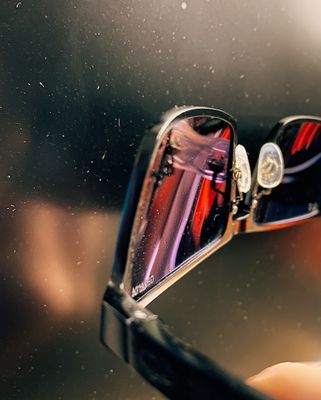
Photo by Leandro Verolli / Pexels
General Glare (Not Glasses-Specific)
Anyone can experience glare from environmental factors, regardless of whether they wear glasses:
- Discomfort glare: Caused by bright light sources that make your eyes feel sore or watery — for example, stepping outside on a bright sunny day without sunglasses. Vision remains clear, but the experience is unpleasant.
- Disability glare: Occurs when intense light "washes out" your retina, temporarily reducing your ability to see clearly — such as oncoming headlights during night driving or sunlight reflecting off snow.
- Reflective glare: Light bouncing off smooth surfaces like glass buildings, water, or car hoods creates bright spots that reduce contrast and visual clarity.
Glasses-Specific Glare
If you notice increased glare specifically after getting new glasses, these factors may be responsible:
| Cause | What Happens | Solution |
|---|---|---|
| Frame/lens size change | Switching to larger or rimless frames allows more peripheral light to enter, increasing edge glare | Allow 1–2 weeks to adapt; consider smaller frames for high prescriptions |
| Prescription or astigmatism change | Adjustments to cylinder or axis values alter how light is focused, causing temporary halos | Normal adaptation takes 1–2 weeks |
| Over-thinned high-index lenses | Excessive edge grinding on strong prescriptions creates a "prism effect" at the periphery | Choose smaller frames for high prescriptions; avoid excessive thinning |
| Poor lens coating quality | Low-quality anti-reflective coatings fail to reduce surface reflections effectively | Upgrade to premium multi-coated lenses |
| Misaligned frame or incorrect PD | Crooked frames or inaccurate pupillary distance causes light to focus abnormally | Have your glasses professionally adjusted |
When to Seek Help vs. When to Wait
Most new glasses discomfort resolves within 1 to 2 weeks of consistent daily wear. Here's a quick guide:
- Normal (wait it out): Mild dizziness, slight peripheral distortion, minor headaches that improve each day, subtle glare
- Needs attention: Persistent headaches after 2 weeks, double vision, significant blur through the lens centre, worsening symptoms over time
- See a doctor: Glare or halos without wearing glasses could indicate dry eye syndrome, cataracts, or other eye conditions requiring medical evaluation
Tips for Faster Adaptation
- Wear your new glasses consistently — switching back and forth between old and new pairs extends the adaptation period
- Start with stationary tasks — reading or computer work before walking or driving helps your brain adjust gradually
- Check the fit regularly — ensure the frames sit level, the lenses align with your pupils, and the nose pads don't allow sliding
- Keep your prescription handy — if discomfort persists beyond 2 weeks, compare your new prescription with your previous one to identify any significant changes
- For driving and outdoor activities — consider polarised or anti-glare coated lenses to filter scattered light and reduce environmental glare
At Lensdy, all our lenses come with premium multi-layer coating that includes anti-reflective treatment, UV400 protection, and scratch resistance — helping minimise glare right out of the box. If you're experiencing persistent issues with your new glasses, don't hesitate to contact our support team for assistance.