

Which Glasses for Running in the Rain Actually Work?
Rain on your lenses at 10 km/h is a very specific kind of annoying: you can see the road, but only through a smeared, shifting kaleidoscope.
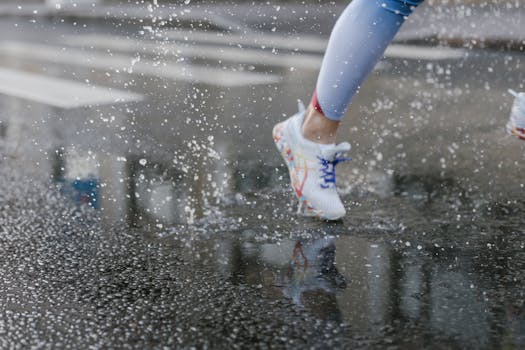
Photo by cottonbro studio / Pexels
The best glasses for running in the rain are lightweight frames that grip without bouncing, fitted with anti-reflective lenses and worn under a cap with a brim. The brim keeps most droplets off the glass, the fit stops slipping on wet skin, and the coating cuts the glare from wet streetlights and headlights.
That combination matters more than any single feature. Below we go through frame fit, lens choices, droplet control, aftercare and which frames we would look at first.
What makes glasses good for running in the rain?
Good glasses for running in the rain stay put, weigh very little and leave a small gap between the lens and your eyelashes. Wet skin is slippery, so a frame that behaves at your desk will creep down your nose within a kilometre once rain and sweat mix. Look for a snug bridge that spreads weight across the nose, temple arms that curve behind the ear or end in grippy tips, and a front that feels almost absent. Metal and acetate can both work, but flexible memory metal and titanium have an edge because they hold their shape when you push them back on with wet fingers. Test the fit at home: shake your head hard, look down at your shoes for five seconds, and see whether the frame moves. If it shifts dry, it will shift wet. Bouncing glasses also blur your view, because the lens moves relative to your eye with every stride.
A quick checklist when you compare frames:
- Bridge width that sits on the sides of your nose rather than perching on the tip.
- Temple arms with a slight inward curve at the ends, not straight rods.
- A lens shape that is not too tall: big, deep lenses catch more rain and more wind.
- Low weight overall, especially if your prescription is strong (see the lens section below).
One more point that generic advice skips: rimless frames look light, but the lens edge is exposed and the screws sit right where sweat collects. They are fine for commuting. For regular wet runs we would pick a full-rim frame.
Shop the frames in this guide


Which lenses are best for running in the rain?
For rain running, the most useful lens upgrade is an anti-reflective coating. Wet tarmac turns streetlights, car headlights and shop windows into starbursts, and an uncoated lens adds its own ghost reflections on top. An anti-reflective coating lets more light through and removes the reflections bouncing between the front and back surfaces. Photochromic lenses are a good second pick for overcast autumn runs, where you move between dim forest paths and bright open roads. For weight, go up in index: 1.61 suits most moderate prescriptions, while 1.67 or 1.74 suits stronger ones, and thinner lenses put less mass on your nose. One caveat: no coating makes a lens rain-proof. Water will land on it. The coating handles glare, not droplets, so droplets are a job for a cap and a bit of technique.
A few specifics worth knowing:
- Single vision is the simplest choice for running. Progressive lenses put the reading zone at the bottom, and wet, uneven paths make you glance down often. The soft blur at the lens edges is more noticeable when you are moving. If you wear varifocals every day, a separate single vision pair for running is worth considering.
- Anti-reflective coating also helps the back of the lens. Light from headlights behind you can bounce off the inner surface into your eye. The coating tames that.
- Blue light blocking lenses are not needed outdoors. Save them for screens.
If you run at dawn or dusk, photochromic plus anti-reflective is the combination we would look at first. Check the product page for how each option is offered with each frame.
How do you keep raindrops off your lenses while running?
Keep raindrops off your lenses by shielding them from above, not by wiping them. A running cap with a brim that projects a few centimetres past the front of your lenses stops most of the water that falls onto your face. Because you move forward, rain also hits at a slight angle from the front, so tilt your chin down a few degrees and let the brim do the work. Droplets that do land bead up because of surface tension, and a single bead in your line of sight is what causes that sudden patch of blur. Resist wiping with a wet sleeve: sleeves carry grit, and grit scratches lenses. Instead, give your head a short sharp shake, or stop for two seconds and dab the lens with a clean microfibre cloth kept in a zip pocket. A cap plus a head tilt solves more rain problems than any product you can buy.
The practical kit
- A cap with a stiff, fairly long brim. Soft, floppy brims collapse in wind and rain.
- A microfibre cloth in a sealed pocket. A cloth that has been in a wet jacket is just a wet cloth.
- A hood only if it does not push your frame sideways. Hoods that sit over the temple arms can tilt the glasses and shift your prescription axis in front of your eye.
- A route with some tree cover for the first run in a new pair, so you learn how they behave before the heavy stuff.
What about fogging?
Fog happens when warm, humid breath meets a cool lens. Rain makes it worse because the lens is already cold and wet. Three things help: keep a small gap between lens and face, let air flow around the frame (a looser neck gaiter or buff, pulled below the nose), and slow down for a moment when the lens clouds rather than wiping it mid-stride. We cover this problem in more detail in our piece on glasses that fog up.
Are sports glasses better than everyday frames for wet runs?
Usually yes, because sports glasses are designed around movement: they stay in place during sprints, stops and changes of direction, and the frame shape is built to take knocks. Everyday frames are designed around looking good at rest. That said, a well-fitted lightweight everyday frame can do fine on an easy 5 km jog, and a poorly fitted sports frame will still bounce. Fit decides it. On a wet run you add slippery skin and extra weight from water, so the margin for error shrinks. If you run more than once a week in autumn and winter, a dedicated pair is easier on both your nose and your everyday frames, which then stay dry and clean for work.
| Frame type | Stays put when wet | Weight on the nose | Our view for rain running |
|---|---|---|---|
| Sports frame (e.g. CourtSharp, DunkVision) | Designed for active movement | Light, built for motion | First choice for regular runs |
| Flexible memory metal | Good, adjusts to the face | Very light | Strong second choice |
| Titanium | Good with the right bridge fit | Very light | Good if you also want a daily pair |
| Thick acetate | Can slide when wet | Heavier | Fine for walks, not for runs |
| Rimless | Depends on bridge and pads | Light | Not for wet, sweaty runs |
We should be straight about our own range. CourtSharp and DunkVision are sports glasses designed for basketball, football, badminton and tennis, not marketed as running glasses. But the reasons they suit those sports (staying in place through sprints, jumps and sudden stops) are the same reasons you want them for a wet run. Take a look at both and judge the fit against your face.
How do you look after glasses that get rained on?
Rinse them, do not dry-wipe them. After a wet run, hold the glasses under lukewarm tap water to wash off salt, grit and road spray, shake off the excess, then dry gently with a clean microfibre cloth. Rain on its own is harmless, but sweat and road salt dry into a film that attacks coatings and corrodes metal parts. Never dry-wipe a lens that has dirt on it: you are dragging tiny particles across the surface. Do not put wet glasses on a radiator or leave them on a hot car dashboard, because heat can warp frames and damage lens coatings. Let them air-dry on a towel at room temperature, with the lenses facing up so water does not pool in the grooves. A weekly look at the screws on the hinges is also sensible, since repeated knocks and temperature changes loosen them.
- Keep a dedicated microfibre cloth in your running bag and wash it regularly.
- Use a hard case rather than a pocket, so the lenses do not rub against keys or phones.
- If your frame has adjustable nose pads, wipe them after each run, since sweat and skin oils build up.
- If the fit loosens over time, ask an optician to adjust the temples instead of bending them yourself.
Cold also changes how materials behave. Cheap plastics get brittle in low temperatures, and a drop on frozen ground can crack a frame that would survive a drop in summer. Handle your glasses gently when you take them off with cold fingers.
Should you run in prescription sunglasses when it rains?
Only on bright wet days, not on grey ones. Rain often arrives under heavy cloud, and dark lenses cut the light you need to read puddles, kerbs and tree roots. Photochromic lenses are the better compromise: clear or lightly tinted in dim weather, darker when the sun breaks through. Wet roads and shiny surfaces create glare even on overcast days, so if you find yourself squinting on bright wet mornings, a pair of prescription sunglasses is useful as a second pair. Lensdy sells around 18 prescription sunglasses styles, including Obsidian, AeroFold, Coastal, Eclipse and Amber. For low light, early dark evenings and anything that looks like proper rain, stay with clear lenses and an anti-reflective coating.
A simple decision rule: if you would not wear sunglasses to walk to the shop in the same weather, do not wear them to run.
Where can you get prescription glasses for running in the rain?
You can order prescription running glasses online from Lensdy, which carries over 200 frame styles, affordable prescription lenses and a range of options: single vision, progressive, photochromic, anti-reflective coating and indices from 1.56 to 1.74. Shipping is free on orders over €59, and most orders arrive within 1-2 weeks, so order a couple of weeks before you need them rather than the night before a long run. Start by working out what you need: light frame, secure fit, anti-reflective coating, and an index that keeps the lenses thin. Then browse the Prescription Glasses collection and compare weights, bridge shapes and materials. If your prescription is strong, our advice is to put your money into the higher index before anything else, because thinner lenses bounce less.
A sensible plan for autumn:
- Pick one sports frame or very light metal frame for runs.
- Add an anti-reflective coating. Add photochromic if you run in changing light.
- Choose the highest index your budget allows if your prescription is above a few dioptres.
- Buy a cap with a proper brim. It is the cheapest upgrade in the whole list.
Frequently Asked Questions
Can you run in the rain with normal glasses?
Yes, if they fit well. Rain will not damage your glasses, but wet skin makes loose frames slide and droplets blur the view. A cap with a brim, a snug fit and an anti-reflective coating make the biggest difference. If your everyday frames are heavy acetate, they will probably bounce on a run.
Do anti-reflective coatings help in the rain?
They help with glare, not with water. In wet conditions, reflections from headlights and streetlights are stronger, and an anti-reflective coating reduces the starbursts and ghost images they create. Droplets still land on the lens, so you still need a brim or cap to keep most of them off.
Are photochromic lenses a good choice for wet runs?
They are a good choice for runs in changing light, such as a cloudy morning that turns bright. They stay lightly tinted or clear in low light, which is what you need on grey, rainy days. For night runs, stick with clear lenses plus an anti-reflective coating.
How do I stop my glasses sliding down when running in the rain?
Choose a frame with a snug bridge and temple arms that curve behind the ear, and keep the lenses light by choosing a higher index. A cap worn over the temple arms can add a little extra hold. If a frame still slides, ask an optician to adjust the fit rather than bending it yourself.
Ready for your next wet run?
Browse the full range at lensdy.com, start with the Prescription Glasses collection, and have your measurements and prescription to hand. free shipping on orders over €59 applies to orders over €59. Before you order, do the shake test on your current frames at home, so you know exactly what fit problem you are trying to fix.