
Aviator Prescription Glasses: How to Get the Fit and Lens Right
Big teardrop lenses look effortless. They are also fussy about your prescription.
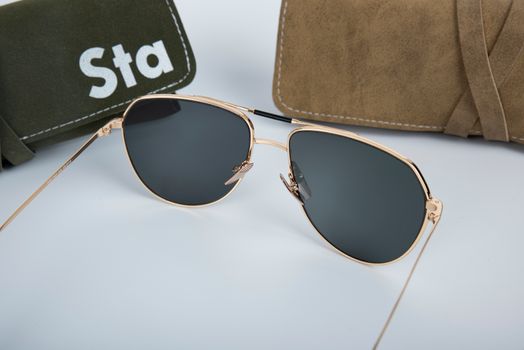
Photo by Emre Vonal / Pexels
Choose aviator prescription glasses by three things: a lens width close to a pair that already fits you, a bridge that sits comfortably on your nose, and a lens index matched to your prescription, going higher as the numbers get stronger. Get those right and the rest is taste.
What size aviator prescription glasses will fit your face?
Start with a pair you already own that fits well. Look at the inside of the temple arm for three numbers such as 58-14-140: lens width, bridge width and temple length, all in millimetres. Aviators are drawn large, so a pair that looks fine in a product photo can swallow a narrow face. Match your current lens width as closely as you can, keep the bridge close to what already sits comfortably on your nose, and pick a temple length near your current pair so the arms reach your ears without pinching. Metal aviators have one advantage over acetate: adjustable nose pads let you fine-tune the fit, which is often the difference between glasses that stay put and glasses you push up all day.
Two quick checks once they arrive:
- Your eyebrows should sit just above the top bar, not hidden behind it.
- The bottom of the lens should clear your cheek when you smile.
Shop the frames in this guide


Which lens index suits an aviator frame?
Aviators need a higher index sooner than smaller frames do, because the lens is large and sits wide. As a rule of thumb, move up from 1.56 to 1.61, 1.67 and then 1.74 as your prescription gets stronger. Go one step higher than you would for a small round frame if you can. The reason is decentration. Add lens width and bridge (58 + 14 = 72 mm) and subtract your pupillary distance (say 62 mm). The 10 mm difference means each pupil sits 5 mm inside the lens centre. In a minus prescription the outer edge is the thickest part, so that offset adds edge thickness. In a plus prescription the lens is thickest in the centre and heavier overall. Treat the table as a starting point and ask your optician if you are near a boundary.
| Prescription strength | Index to consider | What you notice in a large aviator |
|---|---|---|
| Mild | 1.56 | Thin enough, edges barely visible |
| Moderate | 1.61 | Visibly slimmer edges than 1.56 |
| Strong | 1.67 | Keeps weight down on wide lenses |
| Very strong | 1.74 | Thinnest option, worth it in a large frame |
Our pick: if you sit between two indices, take the higher one. The extra cost is small next to wearing a heavy lens on thin wire.
Can you have progressive lenses in aviator glasses?
Yes, and the tall lens is a point in their favour. Progressives need vertical room: the optician measures the fitting height from your pupil to the bottom edge of the lens, and every design needs enough height for the reading zone to fit below the distance zone. A classic aviator has a tall lens, which usually leaves plenty. The catch is the teardrop shape. The lower inner corner curves away, so the near zone can feel slightly narrower than in a rectangular frame, and you may need to turn your head a little more when reading. Choose a frame with a deeper lens, avoid the shallowest vintage-style cuts, and give yourself a week or two of adaptation. Always give your optician-measured prescription and PD when ordering, and ask them whether your progressive design suits a teardrop shape.
- Check the lens height on the product page and avoid shallow cuts.
- Make sure the nose pads hold the frame at a stable height, because progressives are sensitive to tilt.
- Add an anti-reflective coating: night driving with varifocals and bright headlights is much easier with it.
Should aviator prescription glasses be clear, tinted or photochromic?
It depends on where you wear them. Aviators started life as sun gear, and they still do their best work outdoors, but a clear or photochromic pair can be your only pair if you want one frame for everything. Photochromic lenses darken with UV light and clear indoors, which suits a day that moves between indoors and outdoors. They react less behind a car windscreen, because the glass blocks much of the UV that triggers them. For dedicated sun use, a prescription sunglasses pair with a full dark tint is better. Look for 100% UV protection whichever route you take. An anti-reflective coating on the back surface also stops light bouncing off the lens into your eye from behind, which is a common annoyance in large, curved aviator lenses. Skiing is a different job: use goggles such as our Alpine snow goggles, not aviators.
If you want a dark pair as well, the sunglasses collection has styles such as Obsidian, AeroFold, Coastal and Eclipse.
How do you stop aviators sliding down your nose?
Slipping is nearly always a pad or bridge problem, not a temple problem. Thin metal frames rest on two small silicone or plastic nose pads, and if they are too far apart the whole frame sinks until the pads catch the wider part of your nose. Squeeze them slightly closer, a millimetre at a time, using your fingers rather than pliers. Then check the pad angle: the flat of each pad should lie against the side of your nose, not touch it only at an edge. Finally, bend the temple tips down a touch so they hug behind the ear. A heavy lens makes everything worse, which is another argument for a higher index. If the frame still moves, a slightly wider or narrower bridge is usually the cure, and that means a different frame, not more bending.
- Check pad spacing with the glasses on a flat surface.
- Adjust one pad at a time and test them in front of a mirror.
- Wipe the pads weekly: skin oil makes them slippery.
Metal is more forgiving than you might think, but do not bend the same spot repeatedly. Wire fatigues, and a snapped bridge is a bad end for a good pair.
Where can you order aviator-style prescription glasses online?
Start with the Aviators collection, which groups the pilot shapes in one place: metal pairs such as Hamburg Gold and Frankfurt, mixed-material pairs such as Navigator Brown and Eric, and the lightweight aluminium Geneva. Compare lens width and bridge on each product page against the numbers on your current pair. If a full teardrop feels like too much, the wider prescription glasses collection has rounder and squarer shapes such as Squaround Shell. Complete prescription glasses start at €29, with single vision or progressive lenses, 1.61, 1.67 and 1.74 index options, and blue-light or photochromic upgrades. Shipping is free on orders over €59, and most orders arrive within 1 to 2 weeks.
Have your prescription and PD to hand before you start. Both are on your optician's printout.
Frequently Asked Questions
Are aviator glasses suitable for a strong prescription?
Yes, with a high-index lens. At 1.67 or 1.74 the edges stay manageable even in a large lens. Keep the lens width at the smaller end of the aviator range, and ask your optician if your numbers are unusual.
Do aviators suit round faces?
Often they do. The angular top bar and tapered lower edge add contrast to soft features. Go for a lens width that does not extend past your cheekbones.
Can I get aviator prescription glasses with a blue light filter?
Yes. Blue light blocking lenses filter HEV light and can be added to clear lenses. Photochromic and anti-reflective options can be added too, depending on your prescription.
What do I need to order prescription aviators online?
Your current prescription (sphere, cylinder, axis, and add power for progressives) and your PD. Choose a frame size close to a pair that fits you now.
Ready to try the shape? Browse the aviator frames, pick a frame, and enter your prescription at checkout.