

What Lens Index Do I Need? The Complete 2026 Guide
Quick answer
Lens index refers to how efficiently a lens material bends light, with higher numbers creating thinner, lighter lenses. Your prescription strength determines the optimal index: use 1.56 for prescriptions ±2.00 diopters or less, 1.61 for ±4.00 diopters, 1.67 for ±6.00 diopters, and 1.74 for prescriptions above ±6.00 diopters.
Higher index lenses provide significant benefits including weight reduction and improved aesthetics. A typical -4.00 prescription drops from 8-10 grams per lens in 1.56 index to 5-6 grams in 1.67 index, representing a substantial comfort improvement. Frame choice matters considerably—rimless and thin metal frames expose lens edges, making higher index materials essential even for moderate prescriptions around ±3.00 diopters, while thick acetate frames can disguise standard lens thickness. The 1.67 index often provides the optimal balance of thinness and visual quality, as 1.74 index lenses have slightly lower optical clarity due to increased internal reflections despite being thinner.
Choosing the right lens index can dramatically impact both the appearance and comfort of your glasses. The lens index determines thickness, weight, and cost—making it one of the most crucial decisions in your eyewear purchase.
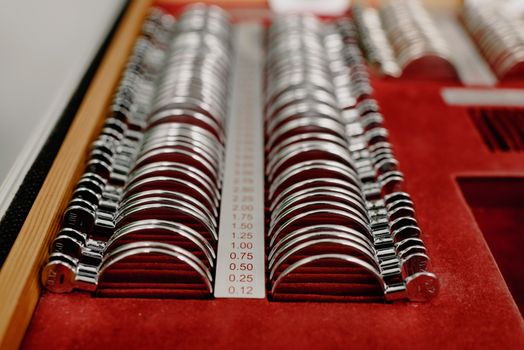
Photo by Ksenia Chernaya / Pexels
Understanding Lens Index: The Science Behind Thickness
Lens index refers to the refractive index of the lens material—essentially how efficiently it bends light. Higher index numbers mean the material bends light more sharply, allowing for thinner lenses even with stronger prescriptions.
The physics is straightforward: materials with higher refractive indices require less curvature to achieve the same optical correction. This translates to significantly thinner, lighter lenses for people with moderate to high prescriptions.
Standard Index Options Available
- 1.50 (CR-39): Basic plastic, thickest option
- 1.56: Mid-index, good balance of cost and thickness
- 1.61: High-index, noticeably thinner for stronger prescriptions
- 1.67: Ultra-thin, premium option
- 1.74: Thinnest available, for very high prescriptions
Shop the frames in this guide


Prescription Strength Guidelines: Which Index Fits Your Needs
Your prescription strength determines the optimal lens index choice. Here's the breakdown opticians use:
| Prescription Range (Diopters) | Recommended Index | Thickness Reduction |
|---|---|---|
| -2.00 to +2.00 | 1.56 | Standard thickness |
| -4.00 to +4.00 | 1.61 | 25% thinner than 1.56 |
| -6.00 to +6.00 | 1.67 | 40% thinner than 1.56 |
| Above ±6.00 | 1.74 | 50% thinner than 1.56 |
Pro tip: Astigmatism correction (cylinder values) also affects thickness. If your cylinder is above ±2.00, consider upgrading to the next index level regardless of your sphere prescription.
Frame Style Considerations
Your frame choice significantly impacts which index you need. Rimless frames and semi-rimless designs expose lens edges, making thickness more noticeable. Full-rim acetate frames like the Cozy can disguise thicker edges better than metal frames.
For residents in Prague or Brno choosing trendy thin metal frames, upgrading to 1.61 or higher becomes essential even for moderate prescriptions around ±3.00 diopters.
Cost vs. Benefit Analysis: Making the Smart Investment
Higher index lenses cost more, but the investment pays off in comfort and aesthetics. Here's what you're actually paying for:
Weight Reduction Benefits
A typical -4.00 prescription in 1.56 index weighs approximately 8-10 grams per lens. The same prescription in 1.67 drops to 5-6 grams per lens. Over a full day of wear—whether you're working in Ostrava's industrial sector or studying in Plzeň—this 40% weight reduction prevents nose pad marks and reduces ear pressure.
Aesthetic Improvements
Higher index lenses eliminate the "bug-eye" magnification effect (for plus prescriptions) and reduce the "small eye" minification (for minus prescriptions). The difference is particularly noticeable in photographs and face-to-face conversations.
Counterintuitive fact: 1.74 index lenses actually have slightly lower optical clarity than 1.67 due to increased internal reflections. For prescriptions between -4.00 and -6.00, 1.67 often provides the best balance of thinness and visual quality.
When to Skip the Upgrade
If your prescription is under ±2.00 and you prefer thick-framed acetate styles like the BlackWarrior, standard 1.56 index saves money without compromising appearance. The thick frame edges will hide any lens thickness anyway.
Special Considerations for Czech Republic Customers
When ordering high-index lenses online to the Czech Republic, factor in the 4-8 business day delivery time for your planning. High-index lenses require more precise manufacturing, so quality matters significantly more than with standard lenses.
Lensdy offers comprehensive lens index options from 1.56 to 1.74, with prescription lenses starting from €29. Based in London (128 City Road, EC1V 2NX), they provide free shipping on orders over €59 across Europe, making high-quality lens index options accessible throughout the Czech Republic.
Consider frames like the versatile SkyAura or comfortable Chill when planning your lens index choice—both styles work excellently with higher index lenses to create a sleek, professional appearance.
Frequently Asked Questions
Can I get progressive lenses in high index materials?
Yes, progressive lenses are available in all index materials from 1.56 to 1.74. Higher index materials are particularly beneficial for progressives since they reduce the overall lens bulk, making the transition zones less noticeable and improving peripheral vision.
Do high index lenses require anti-reflective coating?
High index lenses reflect more light than standard plastic—1.67 index reflects about more light than 1.50 index. Anti-reflective coating becomes essential for indices 1.61 and above to maintain visual clarity and reduce glare, especially for night driving.
Will higher index lenses break more easily?
Higher index materials are generally more brittle than standard plastic. However, proper fitting and quality frames minimize breakage risk. The weight reduction often leads to fewer drops and better overall durability through careful handling.
How do I know my exact prescription strength?
Check the "SPH" (sphere) values on your prescription. Add the absolute values of sphere and cylinder together for each eye, then use the higher number. For example, if you have -3.25 SPH and -1.50 CYL, your effective prescription strength is 4.75 diopters.
Ready to find the perfect lens index for your prescription? Browse Lensdy's collection of over 200 frame styles and customize your lenses with the ideal index from 1.56 to 1.74. Visit lensdy.com to start building your perfect glasses today.