
Aviator Sunglasses for Round Faces: Do They Work? Mostly Yes
Aviators were built for pilots, not for cheekbones, and yet they flatter round faces more often than the classic advice suggests.
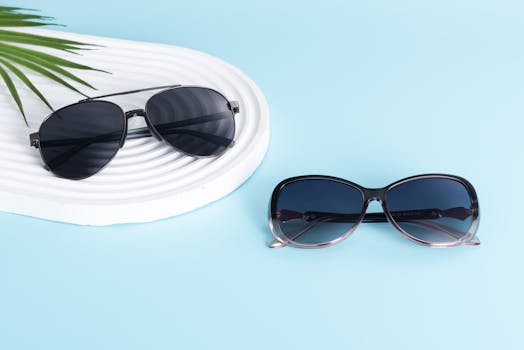
Photo by GlassesShop GS / Pexels
Aviator sunglasses suit round faces when the frame is a little wider than your cheekbones, the top line is fairly flat, and the lens is wider than it is tall (about 45 to 50 mm high is a safe ceiling). The straight brow bar and thin metal rim add the structure a round face lacks. Avoid small, near-circular or very deep teardrop versions.
Do aviator sunglasses really flatter a round face?
Yes, provided the shape adds angles instead of repeating curves. A round face is about as wide as it is long, with a soft jaw and full cheeks, so the eye already reads curves everywhere. A well-chosen aviator brings a flat or gently sloping top line, a straight brow bar and a lens that narrows toward the cheek. That taper pulls attention up and inward, which works against the width across the cheeks. The thin metal rim also keeps the frame light, so you do not add a second heavy circle around the eyes. Where it goes wrong is proportion. A small aviator with a deep, rounded bottom looks like a round frame with a bar stuck on it, and a very large lens swallows a shorter face. We would call aviators one of the easier sunglass shapes for a round face, as long as you check four numbers: lens width, lens height, bridge and total frame width.
Two details do most of the visual work. The first is the brow bar, the thin second bridge running above the nose. It draws a horizontal line at eyebrow level, which gives the upper face a crisp edge. The second is the lower curve of the lens. On a flattering aviator it sweeps inward toward the nose instead of ballooning outward over the cheek.
Round faces do get one advantage here. Because the face is soft, the slightly severe geometry of an aviator reads as contrast, not as harshness. On an angular face the same frame can look like more of the same.
Shop the frames in this guide


Which aviator shape works best on a round face?
For a round face, pick a teardrop with a straight or slightly angled top line, a lens clearly wider than it is tall, and a bottom edge that curves in gently instead of swelling outward. Squared-off aviators, sometimes sold as modern or square aviators, are the strongest choice because their corners supply the angles a round face lacks. The classic teardrop also works if the lens is not too deep. Approach with care any small, near-circular aviator and any version with a full, bulbous lower curve, since both repeat the roundness of your cheeks. Height matters as much as shape. A lens around 45 to 50 mm tall suits most round faces, while anything taller starts to lengthen the lower face and tends to rest on the cheeks. Use the table below as a quick filter before you open a product page.
| Aviator type | Effect on a round face | Our verdict |
|---|---|---|
| Squared or modern aviator | Corners add angles, top line stays flat | Best first choice |
| Classic teardrop, 55 to 58 mm | Taper pulls the eye up and in | Works well if the lens is not too deep |
| Browline-style aviator | Heavier top edge gives strong structure | Good, but can feel heavy on a small face |
| Oversized 62 mm teardrop | Lens covers cheeks and can hide a short face | Try only with a wide, longer face |
| Small, near-round aviator | Repeats the curve of the cheeks | Skip |
If you like the look of a rounder frame and wonder how it differs, the difference is mainly the top line. An aviator keeps it level or slightly angled. A round frame arcs over the brow, and that arc is what a round face does not need.
What size aviator sunglasses should a round face wear?
Aim for a lens width of 54 to 58 mm, a lens height of about 45 to 50 mm, a bridge of 14 to 17 mm and temples of 135 to 145 mm. The total frame width should match or slightly exceed the widest part of your face, usually the cheekbones. A frame narrower than your cheeks makes the face look wider, because the flesh bulges past the edge of the rim. Those figures cover most adult faces, but your own glasses tell you more than any chart. Look on the inside of the temple arm for a string such as 55-17-140: lens width, bridge and temple length, all in millimetres. If your current frames fit well, order within 2 mm of those numbers and change only the shape. Classic aviators are commonly sold in lens widths of about 55, 58 and 62 mm, and the 62 mm size is where many round faces go wrong.
Total frame width is the number people forget, and it is the one that decides whether a frame looks right in a photo. Most adult frames fall between roughly 125 and 145 mm across the front. To check yours, hold a ruler flat across the widest point of your cheekbones and read the distance in millimetres. Then compare it with the frame width listed on the product page.
- Frame width within 0 to 4 mm wider than your cheekbones: the usual sweet spot.
- Frame width narrower than your cheekbones: the rims will pinch and the face will look wider.
- Frame width more than 6 mm wider: the sunglasses will slide and the temples will splay out.
The bridge matters more than it seems on a round face. Fuller cheeks and a lower nose bridge push the lower rims forward into the skin, so a narrow bridge makes things worse. If you often find smudges on the bottom of your lenses, go up in bridge width or choose a frame with adjustable nose pads.
Metal, acetate or titanium: which aviator frame suits a round face?
Thin metal is the classic choice and the one we would try first. It keeps the rims slim, so the lens shape does the styling instead of the frame mass. Titanium behaves the same way visually but is light, corrosion-resistant and hypoallergenic, which helps if you react to nickel in cheaper alloys or if sweat tarnishes metal in summer. Acetate aviators exist, usually with a heavier top edge, and they can look great on a round face with strong brows, though a thick dark acetate rim adds visual weight where a round face needs lift. Flexible memory metal is the most forgiving if you are between sizes or if you keep sitting on your sunglasses. Whatever the material, adjustable silicone nose pads matter more than people expect, because they let you fine-tune where the lens sits relative to your cheeks.
A practical split we would use:
- Everyday and all-day wear: titanium or memory metal, both light enough to forget about.
- A bolder look with a stronger top line: acetate browline aviator, ideally with a slim lower rim.
- A tight budget with a standard prescription: a standard metal frame is fine, as long as the pads are adjustable.
Colour is a smaller decision but worth a thought. Gold and bronze metals soften a round face less than gunmetal, black or silver, which read as sharper lines. If you want the strongest angular effect, go dark and thin.
Can you get aviator sunglasses with a prescription?
Yes, and the lens size is the part to plan around. Aviator lenses are large, so a strong minus prescription leaves a thick edge at the rim and a strong plus prescription leaves a thick centre. Common rules of thumb: 1.56 index for mild prescriptions up to about ±2.00 dioptres, 1.61 for roughly ±2.00 to ±4.00, 1.67 from there to about ±6.00, and 1.74 beyond that. Your optician can refine these for a specific frame. Your pupillary distance (PD) matters as well. Adult PD usually falls between 54 and 74 mm, and the further your pupils sit from the centre of the lens, the thicker one edge becomes. A higher index makes the lens thinner and lighter, which also helps the frame stay put on the nose. On a big lens that weight difference is easy to feel by the end of the day.
Some specifics worth knowing before you order:
- Progressives: a tall aviator lens is a good home for varifocals, because you need vertical room for the reading zone. Many standard progressive designs want roughly 30 mm or more of lens height below the pupil line to work comfortably, so check the frame's listed lens height first.
- Photochromic lenses darken outdoors, but most rely on UV and stay lighter behind a car windscreen. If you drive a lot, do not count on them as your only sunglasses.
- An anti-reflective coating on the back surface reduces light bouncing off the inside of the lens into your eye, which is useful when the sun is behind you. Low autumn sun in Kraków, for instance, comes from just that kind of awkward angle.
- All our lenses block 100% of UVA and UVB when you choose the sun tint, so you are not choosing between style and protection.
Lensdy offers single vision, progressive, photochromic and blue light blocking lens options, along with anti-reflective coating, so you can match the lens to how you actually use the glasses.
What mistakes make aviators look wrong on a round face?
The three that show up most are a lens that is too tall, a frame narrower than the cheekbones, and a lower rim that lands on the cheeks. Each one adds width or length where a round face does not want it. A tall lens stretches the lower face and creates a mask effect. A narrow frame makes the cheeks bulge past the rims. A rim resting on the cheeks lifts when you smile, leaves smudges on the lenses and makes the sunglasses look permanently crooked. The fix for all three is the same: choose a lens that is wider than it is tall, a frame equal to or just wider than your cheekbones, and a bridge and nose pads that hold the lower rim clear of your skin. Test it by smiling widely in the mirror. If the frame jumps, it is wrong for you, however good it looks with a neutral face.
- Choosing the biggest size because it looks more fashionable in photos. Larger is not automatically more flattering.
- Ignoring the bottom curve. Two aviators with the same 56 mm width can sit very differently if one has a deeper lower arc.
- Forgetting weight. A heavy lens in a thin metal frame presses on the nose pads and leaves marks, which you notice after an hour.
- Buying only from one photo angle. Look at the side view too, since a wide temple spread can add to the width of the face.
One counterintuitive point: a slightly bigger frame in a thin metal often suits a round face better than a smaller one. The thin rim keeps the frame from looking heavy, and the extra width balances the cheeks. Size up in width, not in height.
How do you test aviator fit at home before ordering?
Start with the numbers you already own: the three-number string on your current glasses, plus a ruler across your cheekbones. Compare those with the lens width, lens height, bridge and frame width on the product page, then check the shape in a mirror with a hair tie pulled back so nothing frames your face. If the listed lens height is under about 50 mm, the width is within 2 mm of your best-fitting frame and the front is not narrower than your cheekbones, you are in good territory. The remaining uncertainty is about comfort and look, not size. That is where a quick paper cut-out or a photo test helps. You can do the whole process in ten minutes, and it is far cheaper than guessing and sending a pair back.
- Read the numbers on the inside of your best-fitting glasses (for example 54-18-140).
- Measure the width across your cheekbones with a ruler, in millimetres.
- Write down the lens height of any aviator you are considering. Keep it at about 50 mm or less.
- Look at the bridge width. If your current bridge is 17 mm or more, avoid anything under 15 mm.
- Check the product photos for the lower curve. Prefer a gently tapered bottom over a deep, rounded one.
- Take a front photo and a side photo of yourself wearing your current frames, then compare the proportions on screen with the aviator's photos.
A last check: if you wear a progressive lens, make sure the lens height allows the reading zone, and add the fitting height to your order notes if the site asks for it.
Which Lensdy sunglasses are worth trying?
Our prescription sunglasses range runs to about 18 styles, and the quickest route is to open the Sunglasses collection and look for thin metal frames with a level top line. Horizon and Solstice are two to open first and compare against the measurements above. Ruby and BlackWarrior are useful comparisons too: put their listed lens width, height and bridge next to the aviator you like and see how each number changes the fit. We list the measurements on every page so you can do exactly that.
Beyond sunglasses, we carry 200+ frame styles in acetate, metal, titanium, rimless and flexible memory metal, with affordable prescription lenses in indices from 1.56 to 1.74. That means you can use the same measurements to match your everyday glasses to your sunglasses and keep a consistent fit. free shipping on orders over €59 applies on orders over €59, and most orders arrive within 1 to 2 weeks, whether the parcel is going to Poznań, Wrocław or a smaller town.
Frequently Asked Questions
Are aviators too round for a round face?
Not if you choose a squared or flat-topped version with a lens wider than it is tall. The classic teardrop works too, as long as the lens is not deep. What does not work is a small, near-circular aviator with a very full lower curve, because it repeats the shape of the cheeks.
Should I choose a bigger or smaller aviator with a round face?
Slightly wider, not taller. Look for a frame width equal to or just wider than your cheekbones and a lens height of about 45 to 50 mm. A 62 mm lens is too large for most round faces, while 54 to 58 mm usually fits.
Can I get aviator sunglasses with progressive lenses?
Yes. Check the lens height first, since many progressive designs need roughly 30 mm or more below the pupil line. Aviators are tall enough in most cases, but a very shallow, squared version might not be. Ask your optician if you are unsure about your prescription.
How long does delivery take, and what does it cost?
Most orders arrive within 1 to 2 weeks. Shipping is free on orders over €59. If you are ordering both sunglasses and everyday glasses, putting them in a single order is the easiest way to pass that threshold.
Ready to test the numbers on a real frame? Take your measurements, open the Sunglasses collection at lensdy.com and compare lens width, height and bridge before you add anything to your basket.