
What Happens During an Eye Test? A Step-by-Step Run-Through
Nobody fails an eye test. The only way to get it wrong is to guess when you aren't sure.
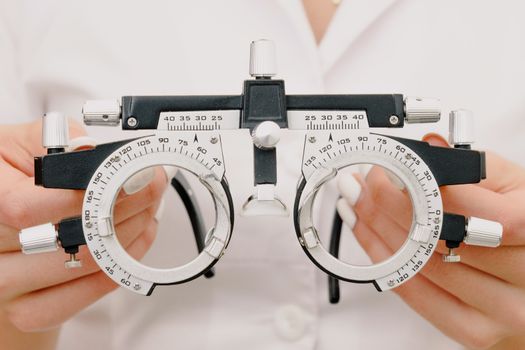
Photo by Ksenia Chernaya / Pexels
A routine eye test has four parts. First comes a conversation about your health and symptoms. Then quick machine measurements of both eyes. Then a chart-based check that finds your prescription lens by lens. Last is a health examination of the front and back of the eye. Nothing hurts, and your main job is saying which view looks clearer.
What happens before the eye test even starts?
Before anyone holds a lens up to your face, the optician asks questions, and your answers steer the whole appointment. Expect to be asked why you booked, whether you get headaches or blur at certain distances, how many hours a day you spend on screens, whether you drive at night, and what your hobbies are. They will also ask about medication, general health, and family history of conditions such as glaucoma or diabetes. Bring your current glasses, because the optician reads their power on a lensometer and uses it as a starting point. The history matters because two people with identical chart results can need different advice: someone who reads on a laptop all day may be offered a different lens design from someone who mostly drives. Be specific. “Words swim after lunch at my desk” is far more useful than “my eyes are tired”.
If you book a lunchtime slot near your office in Rome, say so: a test done when your eyes are already tired from the morning's screen work tells the optician something real.
Shop the frames in this guide


Which machines do they use, and do any of them hurt?
Most of the machines are painless and take seconds. An autorefractor shows you a blurry picture, often a hot-air balloon at the end of a road, and estimates your prescription by bouncing light off your retina. A keratometer maps the curvature of your cornea, which matters for astigmatism. The air-puff tonometer measures eye pressure in mmHg, and it is the one that makes people flinch; the puff is harmless but startling. A retinal camera may take a flash photograph of the back of your eye. None of these produces your final prescription. They give the optician a starting estimate, and a human then refines it with the chart and lenses. Machines also tend to read slightly too much minus power, because your eye focuses automatically on the balloon. That is why the next stage exists.
- Rest your chin and forehead firmly on the supports, so the reading isn't blurred by movement.
- Keep both eyes open and look at the target, even when it goes fuzzy.
- Blink normally just before the air puff, not during it.
How does the “better one or two?” test work?
The “one or two?” part is called subjective refraction, and it is where your real prescription is found. You sit about 6 metres from a letter chart (or a mirror that makes the chart appear that far away) while the optician flips lenses in a phoropter, the big mask-like device, or drops them into a trial frame. Each flip changes the power by a small step, usually 0.25 dioptres, and you simply say which view is clearer or that they look the same. The optician starts from the machine's estimate, finds the sharpest sphere power, then checks for astigmatism by rotating cylinder lenses to find the axis and strength. Finally the two eyes are balanced so neither works harder than the other. There are no wrong answers. “Same” is a legitimate reply, and honest uncertainty gives a better result than a confident guess.
A typical sequence looks like this:
- You read the chart with each eye alone, from the large letters down to the smallest you can manage.
- The sphere power is refined in 0.25 dioptre steps.
- Astigmatism is checked with cylinder lenses, first the axis, then the strength.
- A red and green split on the chart confirms you aren't over-corrected. Letters on the red side should look about as clear as those on the green.
- Both eyes are tested open together to balance them.
- Near vision is tested with a reading card, which is where an ADD for reading or varifocals comes from.
One tip we'd give anyone: when the optician flips between two options, don't hunt for the “right” one. Describe what you see. If the difference is tiny, say so, because tiny differences are exactly what the optician needs to know about.
What does the optician check for eye health?
The health check looks at the structures the chart cannot see. With a slit lamp, a microscope with a bright thin beam, the optician examines your eyelids, cornea and lens. With an ophthalmoscope, or a retinal photograph, they look through the pupil at the retina, the optic nerve head and the blood vessels. Pupil reactions to light and the way your eyes follow a moving target show whether the muscles and nerves coordinate normally. A cover test checks whether your eyes line up at near and far. Sometimes drops are used to widen your pupils for a better view, which can leave you light-sensitive and blurry for a few hours, so ask beforehand whether you should bring sunglasses and avoid driving. Anything unusual is something to discuss with your optician, who may refer you to an ophthalmologist. We can describe the process, but interpreting findings is their job, not ours.
Depending on your age and history, you may also get a visual field check (pressing a button when you see small lights at the edge of your vision) or a colour vision plate test. Both are quick, and both are worth saying yes to.
How do you read your prescription afterwards?
A prescription is a short grid of numbers, and reading it takes a minute once you know the columns. The right eye is OD (occhio destro) and the left is OS (occhio sinistro). SPH is the main power in dioptres: a minus sign means short-sighted, a plus sign long-sighted. CYL and AXIS describe astigmatism: CYL is how much, AXIS is the angle from 1 to 180 degrees. ADD is the extra power for near work in varifocal or reading lenses. PD, pupillary distance, is the gap between your pupils in millimetres, typically 54-74 mm for adults, and it tells the lab where to centre the lenses. If your PD is missing from the paper, ask for it while you are still in the chair. It takes the optician seconds to measure.
| Column | What it means | Example |
|---|---|---|
| SPH | Main lens power, in dioptres | -2.25 |
| CYL | Astigmatism correction | -0.75 |
| AXIS | Angle of the astigmatism, 1-180 | 90 |
| ADD | Extra near power for varifocals or reading | +1.50 |
| PD | Distance between pupils, in mm | 63 |
Your numbers also point to a lens index. A mild prescription sits comfortably in a 1.56 lens. Stronger ones usually look and feel better in 1.61 or 1.67, which are thinner for the same power, and the very strongest are where 1.74 earns its place. Ask your optician what they'd suggest for your numbers.
What should you bring and ask at the appointment?
Preparation turns a routine appointment into a more useful one. Bring your current glasses, any older prescription, a list of medication, and a note of when your symptoms show up. Measure how far your eyes sit from your screen at work, often somewhere between 50 and 70 cm, because the optician can test at that distance and advise on lens design for it. Eat and sleep normally beforehand: a tired, hungry you can give a slightly unsteady result. Finally, ask for a written copy of the prescription including your PD, even if you plan to buy your glasses somewhere other than the practice. It is your data, and having it on paper means you can compare options calmly rather than deciding at the counter.
- Do I need a separate pair for the computer or for reading?
- Is my astigmatism stable, or is it worth watching?
- Would an anti-reflective coating or photochromic lenses suit how I live?
- When should I come back for the next test?
Where can you turn the prescription into glasses?
Once you hold the paper, you can order glasses wherever the price and the frame selection suit you. At Lensdy you'll find 200+ frame styles in acetate, metal, titanium, rimless and flexible memory metal, with affordable prescription lenses in single vision or progressive, plus options such as blue light filtering, photochromic and anti-reflective coating. Have your prescription and PD in front of you while you browse, and match the lens index to your numbers as described above. Most orders arrive within 1-2 weeks, whether you live in Venice, Bologna or a small town in the hills, and shipping is free on orders over €59. That threshold is easy to reach with a frame plus a few lens upgrades.
For a starting point, look at a rounder acetate such as Clark, a lighter metal option like Rotterdam Silver, or Madrid if you want something with a bit more presence. Our Turquoise frame is worth a look if you'd like colour near your face. Check each product page for sizing, and compare the lens width and bridge against your current glasses.
Ready to use your new prescription? Browse the full prescription glasses collection at lensdy.com, and keep your current glasses nearby to compare frame measurements before you order.