

What Are Navigator Glasses and Who Do They Suit?
Ask for navigator glasses and you will often be handed an aviator. Close, but not the same thing.
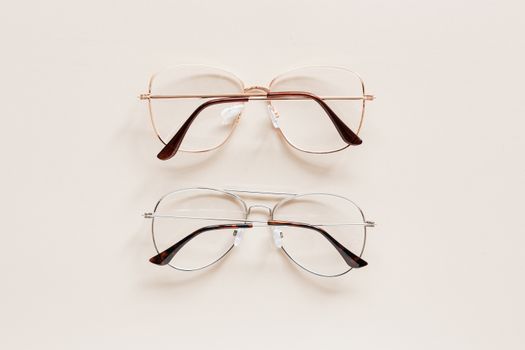
Photo by https://kaboompics.com/ / Pexels
Navigator glasses are thin metal frames with a straight brow bar, a double bridge and squarish, slightly tapered lenses. Think of an aviator with the teardrop straightened out. They flatter oval, round and heart-shaped faces most, and in prescription form they usually work best with lens widths of 52-58 mm.
What exactly are navigator glasses?
Navigator glasses are a lightweight metal frame style built on three features: a flat or gently curved brow bar across the top, a double bridge (a second bar sitting above the nose bridge) and lenses that are squared off and a little wider at the top than at the bottom. The name is not tightly defined, so one brand's navigator is another brand's pilot or square aviator. That is why you should shop by features rather than by label. The frame front is normally thin metal wire, often around 1.5-2 mm in section, which keeps the pair light on the nose. Most have adjustable nose pads on small arms, which matters more than it sounds (we come back to this below). The silhouette reads as confident and slightly retro without looking like a costume, which is why it works in both prescription glasses and sunglasses.
A quick check when you browse: if the top line of the lens is straight, there are two bars across the nose area and the corners are softly squared, you are looking at a navigator.
The three details that give it away
- A brow bar that runs level with the top of the lenses, usually in the same metal as the rims.
- A double bridge: one bar high over the nose, one lower with the pads.
- A lens that is more trapezoid than teardrop, with a flatter upper edge.
Shop the frames in this guide


How do navigator glasses differ from aviators and browlines?
The difference sits in the lens outline. An aviator has a rounded teardrop that is deepest in the middle and narrows towards the temples. A navigator has a flatter top edge and more squared corners, so the lens looks more geometric. A browline has a heavy upper bar, often acetate, with thin wire below, so the visual weight sits on your eyebrows. The navigator keeps everything in thin metal, which makes it lighter in both weight and look. All three can carry a double bridge, but the navigator makes it a defining feature. If you find aviators too soft and browlines too heavy, the navigator is the sensible middle position.
Because the upper edge is straight, a navigator also gives a slightly more usable lens area at the top of your field of view than a teardrop does. That helps if you read or work on a screen with your head level.
| Style | Lens shape | Typical material | Visual weight |
|---|---|---|---|
| Navigator | Squared, slightly tapered, flat top | Thin metal, double bridge | Light, structured |
| Aviator | Rounded teardrop | Thin metal, often double bridge | Light, soft |
| Browline | Rectangular or softly rounded | Acetate top, metal below | Heavy on the brow |
| Round wire | Circular | Thin metal, single bridge | Very light, delicate |
Which face shapes suit navigator glasses?
Navigator glasses suit oval faces without effort, and they are a smart choice for round and heart-shaped faces because the flat top line adds structure where the face is soft. Square faces can wear them too, but pick softer corners so the frame does not repeat your jawline. Very long faces do better with a deeper lens than average, so the frame fills more of the vertical space. The rule of thumb we use: the frame should contrast with your dominant line, not copy it. Straight edges balance curves, and curves balance angles.
Frame width matters as much as shape. The outer edge of the frame should sit roughly in line with the widest part of your face at the cheekbones, with no skin bulging out behind the hinge. A pair that is too narrow pinches at the temples, and one that is too wide slides and tilts.
Quick matching guide
- Round face: choose a lens wider than it is tall, with a clearly flat top.
- Heart-shaped face: a lighter brow bar and slightly deeper lower rim balance a wider forehead.
- Square face: rounded corners and a thinner rim.
- Oval face: almost anything in the range works, so choose on colour and lens size.
Skin tone and hair colour matter for metal finish. Gold tends to warm up lighter and olive skin, while black or gunmetal feels sharper against very dark or very pale colouring. It is a preference, not a law, and trying both in photos on your own face settles it quickly.
What size navigator glasses should you buy?
Most adults land between 52 and 58 mm lens width, 14-18 mm bridge width and 135-145 mm temple length. Look inside the arm of a pair that already fits you: you will find three numbers such as 54-17-140 (lens width, bridge, temple length). Match the lens width within about 2 mm and the temple length exactly, and you will be close. On a double-bridge frame the bridge number matters a little less than on acetate, because adjustable pads do the fine fitting for you. Lens height matters more than people expect: a deeper lens of around 45 mm or more gives more room for progressive lenses and wide-angle viewing, while a shallow one looks neater but limits reading area.
Two details that are easy to miss when ordering online:
- Your pupillary distance (PD). Adult PD is typically 54-74 mm. A frame whose lens centres sit far from your PD forces the optical centre off-axis, which adds edge thickness in stronger prescriptions.
- Brow clearance. The top bar should rest just below your eyebrows, not on them. If it touches skin when you frown, size down in lens height.
One counterintuitive point: a bigger lens is not always the more comfortable pick. Extra width adds weight to the nose pads, so the pair slides more easily on a warm day or after a run for the bus.
Which lenses work best in navigator frames?
For a thin metal frame, lens thickness is the main decision. A rough guide for short-sighted prescriptions: standard 1.56 index is fine for mild strengths, 1.61 suits moderate ones, 1.67 is our usual pick for stronger prescriptions and 1.74 is the thinnest option for very high strengths. These bands are guides, not rules, so if you sit on a borderline, ask your optician. Metal rims are slim, so a thick lens edge shows more than it would behind chunky acetate. Choosing the next index up usually costs less than living with an edge that looks like the bottom of a bottle.
Large squared lenses also have more outer edge to fill, which is why high index matters more here than in a small round frame. The deeper navigator lens also suits varifocals, since there is room for the distance, intermediate and reading zones to sit without feeling cramped.
Coatings worth adding
- Anti-reflective coating: removes the mirror effect from the back surface. It is useful in dark evenings, when headlights and shop windows bounce off lenses. A Dublin commute in November is a fair test.
- Photochromic lenses: they darken outdoors and clear indoors, handy if you want one pair to cover both.
- Blue light filtering: lenses may filter HEV/blue light, which some people like for long screen sessions.
If you want a proper sun version, you have two routes: prescription sunglasses, or a magnetic clip-on set such as the Magneto 3-in-1 or Polyhedron 4-in-1, which add a sun clip (and a blue light clip on the Polyhedron) to your normal prescription frame. Those are separate products with their own shapes, not navigator frames, so check the fit on each page.
Why do metal navigator glasses slip, and how do you fix them?
Metal navigators slip because the contact area is tiny. Two small nose pads carry the whole weight, and any gap between pad and nose lets the frame slide. The fix is nearly always a pad adjustment, not a different frame. Pads should sit flat against the sides of your nose, evenly spaced, and angled so the frame hangs level with the lenses roughly parallel to your face. If the pair slides, bring the pads slightly closer together. If it leaves marks, widen them. Silicone pads grip better than hard plastic ones and are usually easy to swap. Small movements of about 1 mm change the fit noticeably, so make changes in tiny steps and test after each one.
Do the work gently. Hold the pad arm near the base with your fingertips, not the lens or rim, and bend slowly. Forcing a thin rim can distort the lens seat.
Three fit checks at home
- Lean forward and shake your head gently. The glasses should stay put without you pushing them back.
- Look in a mirror: the lenses should sit level, with your eyelashes clear of the glass.
- Wear them for an hour. A red mark across the nose bridge means the pads are too close together or the frame is too narrow.
If you wear them with a winter hat or scarf, the arms can get pushed off the ears. A slight bend at the temple tip, so it curves around the back of the ear, adds grip without squeezing.
Where can you buy prescription navigator-style glasses?
You can order them online from a retailer that lets you choose frame, lens index and coatings separately, which is how Lensdy works. We carry 200+ frame styles, including acetate, metal, titanium, rimless and flexible memory-metal options, with affordable prescription lenses in single vision, progressive, blue light blocking and photochromic, plus anti-reflective coating and indices from 1.56 to 1.74. Orders over €59 ship free, and most orders arrive within 1-2 weeks, including to Dublin and the rest of Ireland. Because navigator is a loose label, we suggest browsing the metal frames in our Prescription Glasses collection and judging by the features above rather than by the name alone.
A few frames worth comparing on shape, colour and size: Hamburg Gold if you like a warm metallic tone, Gerard in Black for a darker, sharper look, Lava and Oscar in Red if you want something a little less expected. Not every frame we sell is a navigator, so read the measurements on each product page and compare them with your current pair.
Frequently Asked Questions
Are navigator glasses the same as aviators?
No. Both are thin metal frames, often with a double bridge, but the navigator has a flatter top line and squarer corners, while the aviator has a rounded teardrop lens. Some brands use the names loosely, so judge by the lens shape.
Do navigator glasses suit round faces?
Generally yes. The straight brow bar and squared corners add definition to a softer face. Choose a lens that is a little wider than it is tall, and avoid very small circular shapes that echo your face outline.
Can I get navigator glasses with progressive lenses?
Yes, and the deeper, squarish lens is a good fit for them because it leaves room for the full distance-to-reading range. Give your optician or the retailer your fitting measurements, and check the lens height on the product page before ordering.
Which lens index is best for a strong prescription in a metal frame?
For stronger prescriptions, 1.67 or 1.74 keeps the edge thin enough to sit neatly in a slim rim. Borderline strengths are worth a quick chat with your optician.
Ready to find your pair?
Measure your current glasses, note the three numbers inside the arm, then browse the metal frames at lensdy.com and pick the lens index that matches your prescription. Add anti-reflective coating while you are there, and remember that orders over €59 ship free.